"Time changes everything except
something within us which is always surprised by change.
" ~Thomas
Hardy
I've been a fan of time travel stories since,
as a second-grader, I watched Charlton Heston discover
the half-sunken Statue of Liberty on a shoreline of a
planet ruled by intelligent apes.
Our planet. Charlton,
understandably, takes the news of his whereabouts badly.
"Oh my God," he says. "I'm back. I'm home.
All the time, it was... We finally really did it... You
maniacs! You blew it up! Ah, damn you! God damn you all
to hell."
Later, in
Escape from the Planet of the
Apes (the third of five Apes movie), three chimpanzees
from the future escape the destruction of the earth by
repairing the same spacecraft Heston had arrived in. The
intelligent apes arrive back in 1973 where one of them
gives birth to the world's first talking ape, thereby
setting the stage for the rise of the apes (something
which has both already happened but has still, in 1973,
yet to happen). A perfect circle. Watching
Escape from
the Planet of the Apes for the first time my brain
looped around and around, trying to get a handle on this
idea.
I think the chief reason that time travel
in fiction and movies has such enduring appeal is that
for all our technological advancements time is still something
we have no control over. Yes, theoretically time travel
is possible but I don't have any friends who have actually
achieved it. And there are occasions in all our lives
when we could desperately use a do-over. Occasions when
such intervention would have prevented terrible disasters.
Then there's nostalgia, the feeling that the past is somehow
closer to perfection than the present. We can hope for
the future (or dread it) and miss the past, but both things
are always beyond reach.
One of my favourite time travel plots occurs
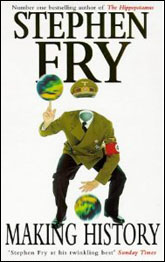
in Stephen Fry's
Making History (1996). Time travel
prevents the birth of Adolph Hitler. This deviation in
history turns the United States into an ultra-conservative
nation where racial segregation still occurs and homosexuality
is a crime. The alternate post-WWII history of the western
world is fascinating and feels credible.
Here are my some of my other favourite time
travel plots, mostly from the film world:
La Jetee/
12 Monkeys: I first
saw Chris Marker's 1962 French sci-fi short
La Jetee
in film school. It's both stark and beautiful and contains
only a brief moment of actual moving footage. The rest
of the film is composed of still-photographs and centers
on a Third World war prisoner who is sent back in time,
in a series of experiments, to seek help for his world
from the future. Director Terry Gilliam made an appealing
full length version of the film in 1995:
12 Monkeys.
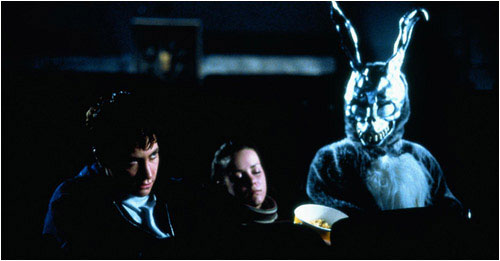
Donnie Darko: A teenage boy is haunted
by visions which include a guy in a creepy rabbit costume
and time lines made visible. Where the hell is all this
going? Trippy as all get out but in the best possible
way.
 |
| Donnie Darko |
The Terminator/Terminator 2: Judgment
Day: Trying to save the future from doom when what's
left of humanity only has access to inferior cyborgs is
an uphill battle. One that we have to wage time after
time. Peristance is everything.
The Time Machine: First published
in 1895, a movie adaptation was produced in 1960 and a
second in 2002. This classic tale of humanity's downfall
— a collapse brought about by scientific "advancement"
— remains as potent as ever.
Groundhog Day: The transformation
Billy Murray makes from perpetually irritated self-centered
newsman to a well-rounded human being when he finally
stops fighting the fact that the rest of his life might
well be spent in the same winter day is hilarious, warm
and wise.
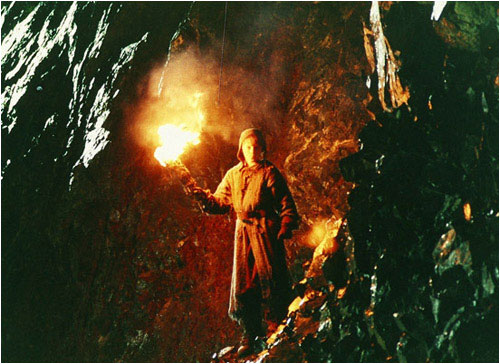
The Navigator: A Medieval Odyssey:
The Black Death is sweeping 14th century England. A Cumbrian
village boy's visions inspire a group of his fellow villagers
to tunnel through the earth and erect a cross in an attempt
to ward off infection. The journey through the earth leads
the travellers to 20th century New Zealand, a place they
struggle to understand as they race to fulfill their quest.
 The Navigator: A Medieval Odyssey
Planet of the Apes/Escape from the Planet
of the Apes: The 1968 film was based on a 1963 book by
Pierre Boulle. The horrifying idea that we might one day
devastate the planet through human invention (atomic bombs)
was much newer when these films were released than it
is now. In fact, the rise of an ape civilization after
a nuclear war would now appear to be the good news. There's
something intriguing about watching our nearest biological
relatives follow in our footsteps in these films.
Looper: In 2044, where time travel
is possible but illegal, a crime syndicate has come up
with a handy workaround to help them wipe out their enemies
and, ultimately, the assassins themselves. When hitman
Joe is sent back in time to be killed, young Joe is the
one about to pull the trigger. Until he discovers who
his target is. And this is just the first few minutes!
A must-see for people who like their action movies smart.
Lost: "Think of the island as
a record, spinning on a turntable," Daniel Faraday
said. "Only now, that record is skipping." Whatever
you say, Faraday! Time travel back to the 70s was only
one of the treats in Lost's goody bag. I think the main
reason we devoured all the weirdness (including temporal
disturbances) was our fondness for the characters who
remained three-dimensional no matter what was thrown at
them.
Life on Mars: BBC police procedural
show about a cop who wakes up in 1973 after a 2006 car
accident and aims to enlighten the '73 police force while
hoping for a return to the future. This show simultaneously
inspires nostalgia for a less politically correct time
while we also root for main character Sam Tyler in his
efforts to, in effect, make the future arrive faster by
putting his progressive twenty-first century ideas into
action.
Being Erica: Emotional Canadian time
travel drama about a woman whose temporally gifted therapist
allows her to work out her various issues by travelling
back to certain parts of her life and redo them. Erin
Karpluk plays the likeable Erica Strange (intrepid time
traveller!) and Torontonians will especially enjoy the
local scenery, from Centre Island to Casa Loma.
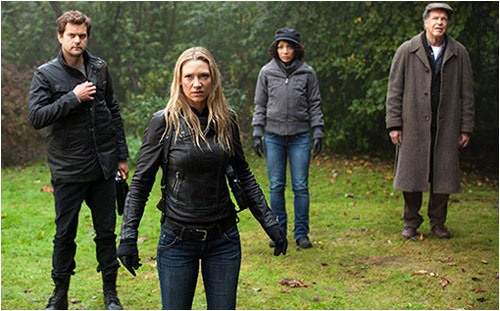
Fringe: I've seldom been so sorry
to see a series end. For five seasons Walter Bishop was
the smartest man on television and Olivia its greatest
hero. Fringe featured astounding plotlines hinging
on parallel universes and a race of people called Watchers
who have mastery over time. But it never forgot the humanity
of its central characters and the importance of their
relationships with each other. Love. Sacrifice. Hope.
Courage. On Fringe these qualities endured across
time and place proving a wonderful inspiration.
 |
| Fringe |